
This Israeli Company Built a Brain Patch That Heals, Then Disappears.
For most of a century, the alternative was tissue from a cadaver.

Everyone assumes the scary part of brain surgery is the obvious part, the surgeon cutting near the brain, getting the tumor out. That part is hard. But what tends to go wrong afterward is the closing.
Because the brain is wrapped in a thin membrane, and once a surgeon has cut through it, that membrane has to be closed up again so it holds. If it isn’t, an operation that just succeeded can quietly come undone in the days after.
For most of the last century, one of the standard ways surgeons closed it was with a piece of somebody who had died.
That’s not a metaphor. There was a product, sold to hospitals, that was exactly this. Human tissue, harvested from cadavers, freeze-dried, sitting on a shelf until a surgeon needed to seal up the membrane around a living person’s brain. It had a brand name, Lyodura, and a price, around $300 for a piece the size of a postage stamp, and for years it was simply how this was done.
And the maker pooled its donors together and kept no records tracing any one graft back to any one body, so nobody could say for certain what was in the tissue. Some of it, it turned out, carried a disease.
I’ll come back to that, because it’s the whole reason the thing I actually want to tell you about exists. But first it’s worth understanding this membrane, because I didn’t, and once I did I couldn’t believe how little anyone thinks about it.
The Whole Thing Hangs on a Membrane Two Sheets of Paper Thick
Your brain floats. There’s a cushion of clear fluid around it that keeps it from bruising against the inside of your own skull every time you trip off a curb or get rear-ended at a light. Something has to keep that fluid sealed in, and that something is a tough membrane, wrapped around the whole brain and spinal cord, no thicker than a couple of sheets of paper. Doctors call it the dura mater, which is Latin for “tough mother.” It is the last waterproof layer you’ve got.
Any time a surgeon needs to get inside the skull, to take out a tumor or stop a bleed, they have to cut through it. And a dura that doesn’t seal back up is a serious problem. The fluid finds its way out, and now there’s an open channel running from the outside world straight to the surface of the brain. That’s one of the ways a surgery that went perfectly still ends in meningitis, or a second trip to the operating room a week later.
And here’s the catch that makes the whole thing hard: the cut edges of the dura often won’t come back together on their own. Especially down in the tightest, most crowded part of the skull, near the brainstem, where the membrane is thin and there’s no slack to work with.
So the surgeon needs a patch. Which brings us back to where those patches used to come from.
The Disease That Waited 20 Years
The disease riding in some of that cadaver tissue was Creutzfeldt-Jakob, the human cousin of mad cow.
What makes it a nightmare is what causes it. The culprit isn’t a germ at all, but a protein folded into the wrong shape, called a prion. Once it’s inside you, it knocks your own healthy proteins into that same wrong shape, one after another, like a bad domino you can’t stop. You can’t sterilize it out of the tissue, because it isn’t alive to begin with. Heat doesn’t touch it. So it went in with the patch, and then it waited.
And it didn’t wait days. This is the part that’s hard to hold in your head. It waited a median of 13 years, and in some people as long as 30, and then it started taking the person apart from the inside, and there was nothing anyone could do, because there is no cure and nobody survives it.
In Japan alone, 154 people were infected this way, more than 60 percent of every case ever recorded on earth, and that one brand, Lyodura, was the graft in 140 of them. There was never an international recall. The stuff had a long shelf life, so it just kept getting used, and it wasn’t until 1997 that health authorities finally told the world to stop using cadaver dura for good.
Look at it from the patient’s side. You come through your surgery fine. You go home. You get 20 good years. And the thing that finally kills you was sewn into your head the day they saved your life.
After that, the field mostly moved to animal tissue, usually the sac around a cow’s heart, cleaned up and processed into a graft. Safer than a corpse, no question, and still a workhorse in operating rooms today. There are man-made collagen patches now too. But anything that was once part of an animal can still make the body inflame or wall it off, and it never fully sheds that same quiet question of what else might be coming along with it. The gentlest option was often to skip the outside tissue altogether and cut a small patch from the lining of the patient’s own skull. That works. It also means opening a second wound to go get it.
A corpse, a cow, or a second hole in the patient. Those were the choices, and surgeons picked the least-bad one case by case, for a hundred years. Plenty of people tried to build something out of material that had never been alive at all, and they kept hitting the same wall. You could make a synthetic patch that sealed the leak, or one that let your own tissue grow back through it, but nobody could manage both in something thin enough to sew into a membrane this delicate.
That’s the wall a small company in Israel decided to walk up to.
So They Started With Thread
The company is Nurami Medical, based in Haifa. Their patch is called ArtiFascia, and the whole idea lives in how it’s made.
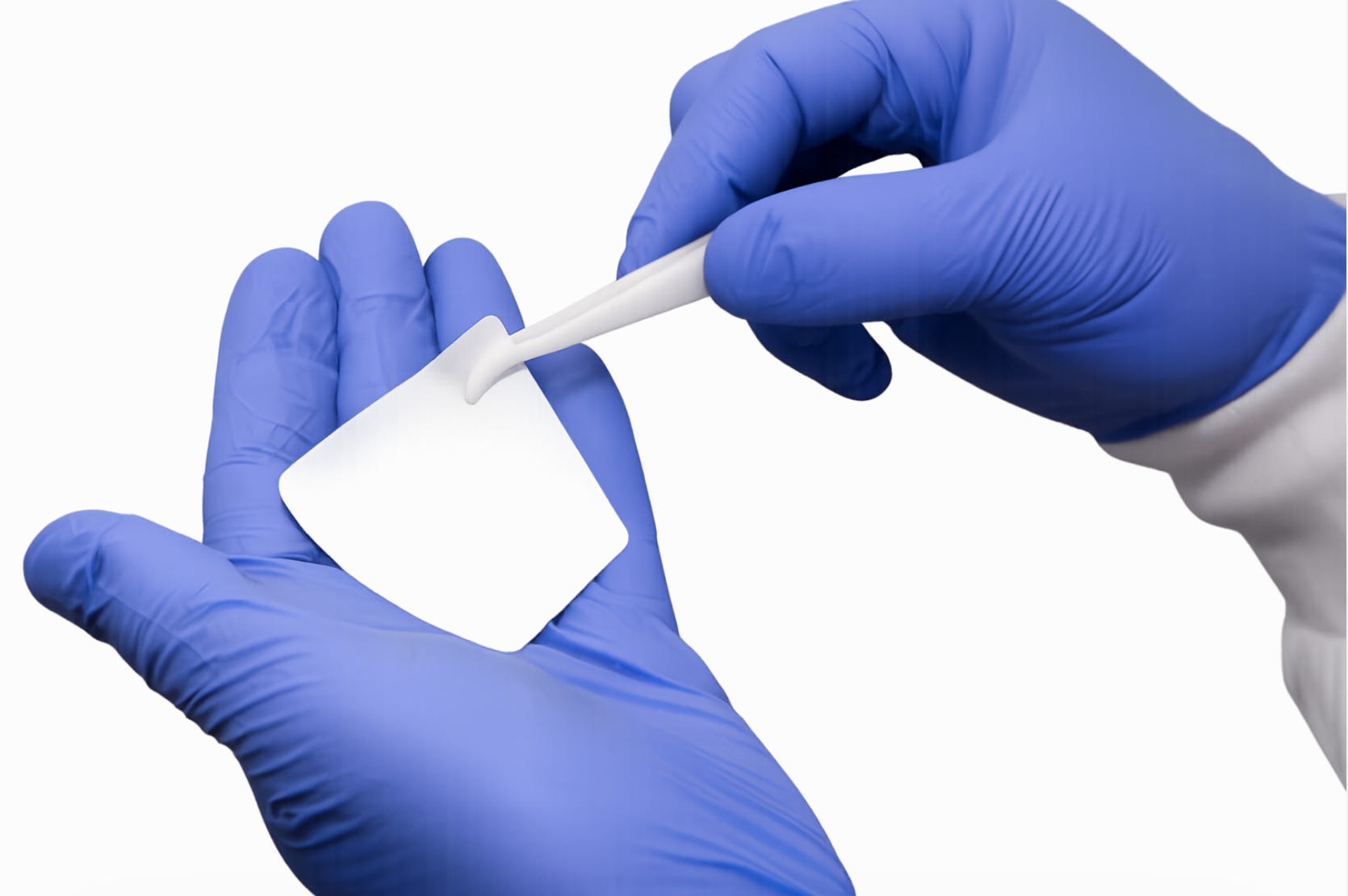
They don’t start with a sheet of anything. They start with thread. There’s a process called electrospinning that draws a medical-grade polymer out into fibers far finer than a human hair and lays them down into a fine mesh. To give you a sense of scale, a human hair runs about 70 microns across, and these fibers are a small fraction of that.
Wound into a scaffold, that mesh doesn’t read to your body like a foreign object. It reads more like a trellis, close enough to the natural scaffolding your own cells already build on that new dura grows right into it and through it. The company’s way of putting it is that the mesh is engineered to promote dural tissue regeneration. In plain terms, your own body rebuilds the membrane, using their thread as the frame to climb, and once the wall is yours again, the frame dissolves and clears out. That’s the part the old synthetics could never pull off.
Then there’s the clever bit, and it solves a problem you’d never think of. The place a dura patch tends to leak isn’t the patch. It’s the stitch holes. You sew a patch down to stop a leak and the needle leaves you a fresh row of tiny holes to leak from. So Nurami built a second layer into the middle of the graft, a solid one with no pores, meant to seal off that leakage at the stitch holes and keep bacteria from getting through.
The whole thing comes out to about 0.35 millimeters thick, just about the same as the real dura it’s filling in for, soft enough that the surgeon can suture it in like anything else.
And it’s completely synthetic. One of the first things Nurami lists about it is that there’s no animal or human material in it, none at all. Put that plain little line next to the Lyodura story. There is nothing in this patch that was ever alive, which means there is nothing in it that can carry what Lyodura carried. A hundred years of that particular horror, answered by a single decision about what to make the thing out of.
For a Century, Surgeons Had Three Bad Options. The FDA Cleared a Fourth.
ArtiFascia earned its FDA 510(k) clearance in August 2023. That’s the route a device takes to market by proving it holds up against products doctors already rely on. It’s cleared as a dura substitute for repairing the dura mater, for tears of 25 square centimeters or less, a bit smaller than a playing card. It started going into American patients in early 2024, and it’s in operating rooms here now.
Behind the clearance is a trial the company ran, called NEOART. It was done the careful way, patients randomly assigned and the people judging the results kept in the dark about who got which patch, across seven hospitals outside the United States, putting ArtiFascia head to head against the grafts already on the market. They enrolled 85 patients and treated 78, most with ArtiFascia and the rest with a patch that was already cleared.
The bar they set for themselves, in the FDA’s own words, was to come out non-inferior. That word deserves a translation, because it sounds like a knock and it isn’t one. It’s the standard a challenger has to clear to earn a spot in the operating room: proof that the new thing does the job at least as well as the trusted thing already in use, measured straight across. And it’s a genuinely high bar, because the trusted thing works.
The company wasn’t out to prove it had beaten everyone. The claim was narrower and harder to argue with: that a fully synthetic patch, one that skips the cadaver and the cow and the second wound entirely, could hold the line as well as anything surgeons already trust, and leave the patient’s own healed membrane behind when it’s finished. It did.
Now, Let’s Be Honest About It
A few things need saying plainly. This is a device that makes an operation safer. It is not something you or anyone you love goes out and asks for, and no patient ever picks their own dura patch off a shelf. If someone in your life is heading into brain or spine surgery, this graft is one small decision buried inside a much larger one, and it belongs entirely to the surgeon, who’s weighing this exact tear, this exact patient, this exact operation. Some cases will still call for other materials, and ArtiFascia is cleared for tears up to a certain size, not for everything a surgeon runs into.
And the trial showed it’s a genuinely solid alternative, not a miracle. Non-inferior is the honest word, and I’m going to keep using it. The patch doesn’t heal anyone faster. All it sets out to do is seal the membrane, let the body grow the real thing back, and then get out of the way. If surgery is actually on the table for you, the only question worth anything is the one you take to your surgeon, not the one you take to a newsletter.
What This Israeli Company Actually Built
Think about what this patch actually does.
The most protected organ you have, the one your entire skull exists to guard, and for a hundred years the best medicine could offer when its lining tore was a piece of something secondhand. A cow. A cadaver. A chunk of the patient’s own skull. Every one of them dragging some kind of shadow in behind it.
This one came from no one. It’s thread, spun in a lab, laid over the tear. And then it does the thing none of the borrowed tissue could ever do. It gives your body a frame to rebuild its own wall on, and once that wall is yours again, it dissolves and is gone.
It’s inside people’s heads right now, in hospitals across America, doing that work for patients who will never learn the company’s name or the country it came from. Built by a small team in Israel, for anyone in the world who ends up on that table.
Built in Israel. For everyone.
Nothing here is medical advice. ArtiFascia is FDA 510(k) cleared as a dura substitute for the repair of dura mater, for defects of 25 square centimeters or less, and is placed by a surgeon. In its NEOART clinical study, the standard it was measured against was non-inferiority, meaning it performed at least as well as the dural substitutes already on the market, on both effectiveness and safety. Anyone facing neurosurgery should talk to their own surgeon about what’s right for their case.